
Ask most people when burglaries happen and they’ll say the same thing: late at night, when everyone’s asleep. A masked figure. A broken window. Darkness.
The FBI’s data says otherwise — and the gap between what people believe and what actually happens has real consequences for how they protect their homes.
The Numbers That Should Change How You Think About Home Security
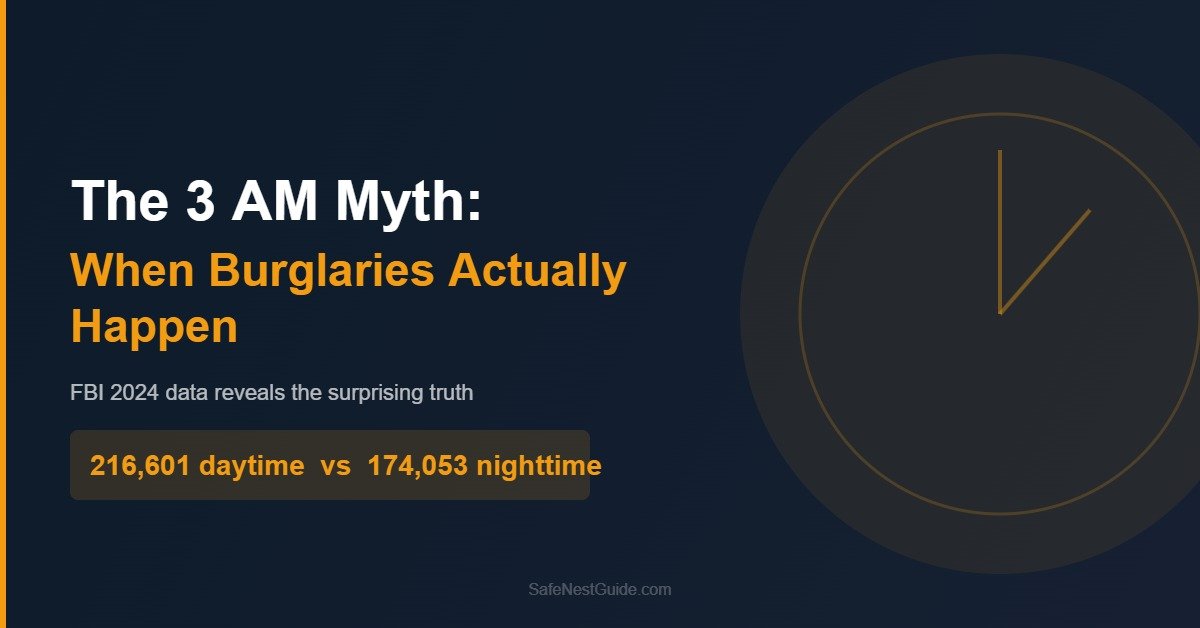
According to the FBI’s 2024 Crime in the Nation report — the most comprehensive dataset available on burglary in the US — 216,601 residential burglaries occurred during the daytime, compared to 174,053 at night. That’s residential burglaries specifically, not commercial ones. Your home is more likely to be broken into at 11am on a Tuesday than at 2am on a Saturday.
The peak window, consistently documented across multiple years of FBI data: 10am to 3pm. The lunch hour — around 12:30 to 1:00pm — is particularly active. These are the hours most adults are at work, most older kids are at school, and most homes sit empty with predictable regularity.
The breakdown over time is consistent. The FBI reported 290,909 daytime burglaries compared to 195,884 nighttime burglaries in 2019. Daytime home burglaries outnumbered nighttime incidents in 2024 as well, reflecting criminals’ preference for targeting unoccupied homes during typical work hours. This isn’t a blip. It’s a structural pattern that holds across years and regions.
Why Daytime? The Burglar’s Logic
This pattern makes sense once you understand what burglars are actually optimizing for. The research is consistent: most burglars aren’t looking for confrontation — they’re avoiding it. The UNC Charlotte study of 422 convicted burglars found that the primary factors they considered when selecting a target were occupancy signals — is anyone home? — and escape routes. An empty house in the middle of the workday offers both: no one to encounter, and normal daytime street traffic that provides cover for a person moving around a neighborhood without looking suspicious.
At 2am, a person on foot in a residential neighborhood is conspicuous. A car parked outside a dark house is notable. Neighbors with insomnia might look out their window. At 11am, a person walking up to a front door looks like a delivery driver, a neighbor, or a contractor. The same activity is invisible in daylight.
Frequent home invasions happen between the hours of 10am and 3pm when homeowners are commonly away. 72% of burglaries happen when nobody is at home. Both figures are connected: burglars time their activity to coincide with vacancy. The “3am myth” misses this entirely.
The Seasonal Pattern Compounds the Problem
Time of day isn’t the only pattern worth knowing. Burglaries follow a clear seasonal rhythm: July and August are the peak months, with rates nearly 11% higher than winter averages. The reason is the same logic applied to a longer timeframe — summer is when homes are most predictably empty. Families travel. Vacation schedules are publicly knowable. The neighborhood is quieter.
February is consistently the lowest-burglary month. People are home, weather discourages outdoor activity, and daylight hours are short — which reduces the daytime vacancy window that burglars exploit.
The practical implication: your risk is highest on a weekday morning in July when you’re at work, not on a December night when you’re asleep in bed. The security setup that protects against the second scenario may be quite different from one optimized for the first.
What the Myth Gets Wrong About Security Design
The “nighttime burglar” model leads to specific, mostly wrong security decisions:
Wrong: Focusing security lighting on nighttime deterrence
Motion-activated floodlights are a standard security recommendation. They do serve a purpose — but primarily at night, for a scenario that represents the minority of actual burglaries. If you’re optimizing for the actual threat, daytime visibility matters more: trimmed hedges that don’t provide concealment at the front of the property, clear sightlines from the street to your entrance, no overgrown shrubbery hiding the side gate. A burglar approaching your front door at noon is visible to your neighbors if there’s nothing blocking the view. That visibility is free and often more effective than a light that only switches on after dark.
Wrong: Assuming being home keeps you safe
27.6% of all home burglaries occur when someone is home. This is the statistic that should concern people most. The majority of these involve burglars who didn’t realize the house was occupied — they checked (often by knocking or ringing the doorbell first) and got no response, then proceeded. The presence of a car in the driveway, audible sounds from inside, or an answer at the door stops most of them. But “being home” in the back bedroom with headphones on while someone enters through the front door is a documented scenario.
Wrong: Assuming vacation and nighttime are your highest-risk periods
Most people take extra precautions before a vacation — timers on lights, asking a neighbor to collect mail, pausing deliveries. These are good habits. But the data suggests the higher frequency threat isn’t your two-week vacation; it’s the five hours you’re reliably at work every weekday. Your home follows a predictable vacancy schedule that anyone who’s observed it for a week can identify. The casual opportunist doesn’t need to case your home for days — they just need to notice your car leaves at 8am and comes back at 6pm.
What the Data Says Should Actually Change
If daytime is the primary threat window, the priority order for home security shifts in specific ways:
Occupancy signals matter more than alarm hardware
The single most effective daytime deterrent is making your home look occupied. A car in the driveway. Lights on in a front room on a timer set to random intervals, not a predictable schedule. A radio or TV audible from outside. These are free or near-free measures that directly target the vacancy pattern burglars exploit. The KGW news survey of convicted burglars listed a car in the driveway as one of the top deterrents — ranked above security signs, cameras, and lighting.
Smart monitoring for when you’re away, not asleep
A security camera that sends you a motion alert while you’re at your desk at work is more practically useful than one designed to alert you while you’re asleep. The 10am to 3pm window is when you most need to know what’s happening at your front door and driveway — and when you’re most likely to be able to actually respond. A video doorbell with two-way audio covers the “burglar knocking to check occupancy” scenario directly: answering the doorbell from your phone, even if you’re miles away, signals that someone is home.
The visible deterrent matters most during daylight
Alarm signs, camera housings, and yard signs work because burglars see them before attempting entry. This deterrence effect is entirely daytime-dependent — at night, a sign is invisible unless it’s lit. The same logic applies to cameras: a visibly mounted outdoor camera at the driveway approach is spotted during the daylight reconnaissance that precedes most break-ins. Its deterrent value is in being seen before entry is attempted, not in capturing footage after.
The Honest Takeaway
The 3am burglar is a real thing — but a minority thing. In 2024, 53.4% of residential burglaries occurred during the daytime, while 42.9% were perpetrated at night. The gap isn’t dramatic, but the direction is consistent across every year of FBI data available. Daytime is the primary threat window. Weekdays during work hours are the highest-frequency risk period. Summer amplifies both.
None of this means nighttime security doesn’t matter. It means that a security setup designed only around the nighttime scenario is protecting against roughly 43% of the actual threat while leaving the more common 53% less covered.
The practical changes are simple: randomize your light timers, answer your doorbell remotely while at work, make your car’s presence in the driveway irregular enough to create uncertainty about occupancy, and position outdoor cameras to cover daytime approach paths — not just front door close-ups. None of it requires a major investment. Most of it requires updating a mental model that the data has been contradicting for decades.
For the gear side of this, see our guides to the best wireless outdoor cameras, best video doorbells, and best home security systems — all chosen with the actual threat pattern in mind.